Bamboozle
Introduction
In response to the UK’s cost-of-living crisis, this project explored how design can promote low-impact living. Through research and service design methods, it proposed a sustainable furniture rental and refurbishment service—centred on transparency, quality, and the use of materials like bamboo—to encourage conscious consumption in a strained economic landscape.
Overview
This report presents a comprehensive research plan to encourage the adoption of sustainable furniture options among 20–45-year-old UK residents amid the cost-of-living crisis.
Initial surveys and competitor analysis identified a general lack of awareness, lack of trust, and affordability constraints as a hindrance to sustainable furniture adoption. After much exploration, sustainable rental furniture emerged as the most viable solution to encourage sustainability adoption.
The proposed concept is an innovative bamboo furniture rental platform focused on transparency, and quality assurance. Features include sustainability certifications, quality assurance badges, transparent rental contracts, and flexible lease terms. By providing clear product provenance and care guidelines, the service aims to build consumer trust in eco-friendly, high-quality rental furniture.
Potential impacts span environmental benefits through reduced waste and sustainable supply chains, enhanced affordability for sustainable options, and shifting mindsets from ownership to user-ship models. A role-playing prototype evaluation plan allows iterative user feedback for concept optimisation.
By addressing economic barriers, raising awareness, and offering innovative rental solutions, this project contributes valuable insights towards promoting responsible living while navigating financial constraints.
Introduction
To help solve an important challenge of how we might encourage lower ecological footprint lifestyle changes amid the cost-of-living crisis in the UK, an efficient toolbox comprising of research and design tools and methods were created, adapted, and iterated along the way. Having a process, mindset and a common language set prior optimized the impact of the selected tools and methods in terms of arriving at the concept of a sustainable rental and refurbishment service with a primary focus on transparency and quality from the initial gathered data proving bamboo as one of the best sustainable alternatives to other furniture materials. A practical approach to creation and improvement of the existing services was followed through the principles of service design—human centred, collaborative, iterative, sequential, real, and holistic.
This service design report is divided into sections about research plan, key findings, problem framing, solution or concept, prototype and evaluation done in detail. It is done with an aim to contribute to sustainable living practices in the UK, fostering responsible consumption habits amid a cost-of-living crisis.

Literature review—Bamboo in the UK



Primary research


Key Findings
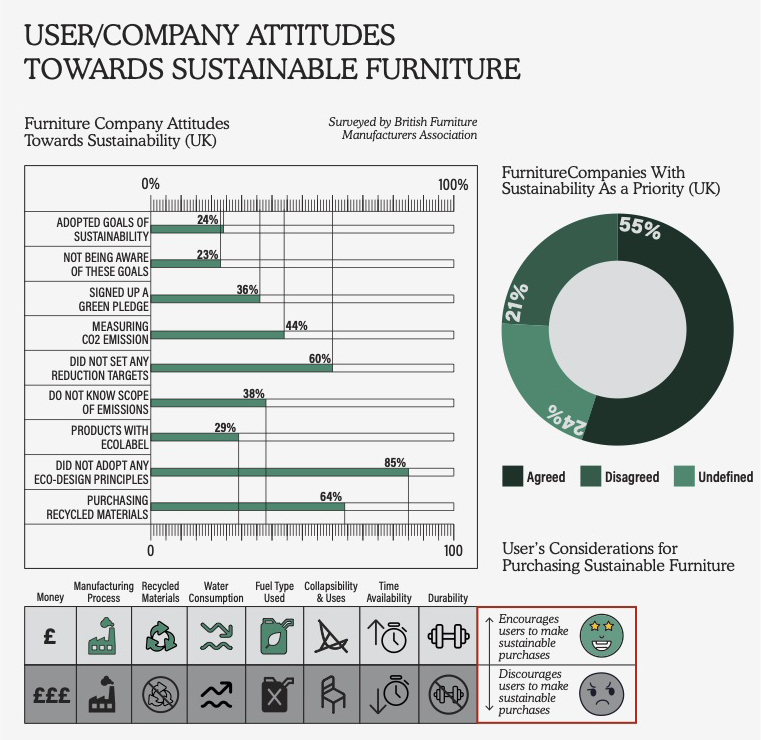
Lack of awareness about sustainable furniture
Lack of transparency around sustainable practices in general
Lack of trust in sustainability claims
High cost of existing sustainable furniture brands
Limited variety & styles in existing sustainable furniture options
Research plan
The research plan for this project includes an interplay of convergent and divergent- thinking and doing to identify and work towards solving the right problem (Appendix A -J). To offset different forms of research bias - researcher triangulation, method triangulation and data triangulation were implemented.
An exploratory study on how we might encourage 20–45-year-old UK residents to lower ecological footprint lifestyle changes amid the cost-of-living crisis led to secondary research about the sustainable furniture market in the UK. It led to further exploring people’s attitudes towards buying sustainable furniture and the factors influencing their decision in the current cost-of-living crisis through a survey and interview, analysed through quantitative and thematic analysis (Hollway and Jefferson, 2000). A competitor analysis followed to assess the strengths, weaknesses, and strategies of existing sustainable furniture services (Bensoussan, 2003). The findings from these methods were clearly defined into a report resulting in the framing of an initial problem statement from the 5 Why’s method to understand the root cause of the problem and 4 W’s method to make sure we have understood enough of it.
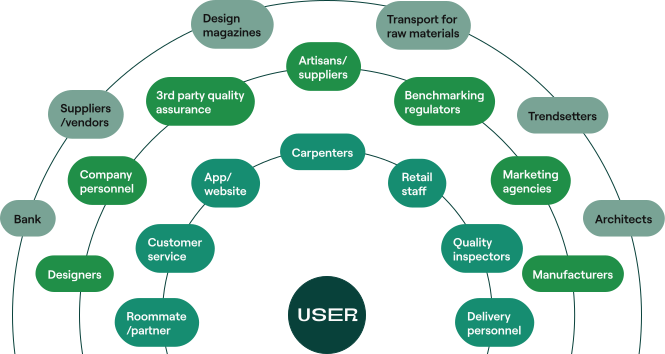
With earlier findings directing towards alternative affordable methods of adoption sustainable furniture other than buying, a literature review on rental furniture services and a survey was conducted to learn about people’s attitudes towards renting sustainable furniture as an eco-friendly, affordable alternative and was analyzed through quantitative and thematic analysis. Upon receiving positive responses to the concept of renting, a competitor analysis of the existing furniture rental services was conducted. Converging into the defining phase again, user needs and pain points were defined through user stories and personas (Miaskiewicz and Kozar, 2011). The current customer experience when interacting with a rental furniture service was visualised through a user journey map (Endmann and Keßner, 2016). Further, stakeholders within this ecosystem were visualised through a stakeholder map (Smith and Fischbacher-Smith, 2000). These definitions resulted in framing the problem statement by reusing the 5 Why’s and 4 W’s methods.
Problem Statement
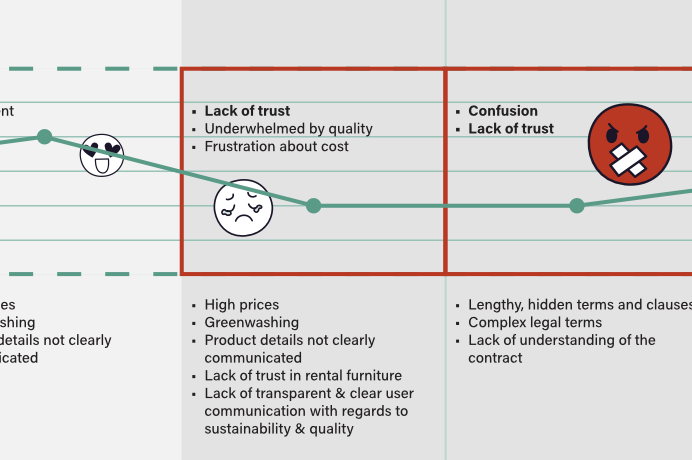
Consumers seeking temporary or sustainable furniture rentals face limited trustworthy options, with concerns around quality, transparency, and hidden costs.
Key Findings & Problem Framing
For procuring key findings of design thinking, initially the double diamond method was favored. However, after a few findings it was quickly realised via iteration and adaptation that this study insisted on adding another diamond to the process.
There were various permutations and combinations of primary research, secondary research along with qualitative and quantitative research methods. These methods allowed the study to understand current demands of the audience for affordable sustainable furniture adoption alternatives.
In the initial stage, secondary research and primary research was conducted. This research led the study towards sustainable furniture. Furthermore, the research ventured various materials such as hemp, foam, recycled materials that could have been a better option, however, each of these products came with challenges such as import charges, freight charges or recycling processes that costed way more which defeated the purpose of finding an affordable option because of the current cost of living crisis. Additionally, furniture companies which priorities sustainable furniture were also considered, the drawback these companies carried were bereft products. These products were mainly less ‘à la mode’ or did not match any aesthetic for them to be chosen or used. Hence this study insisted on finding a solution that has none of the mentioned drawbacks, can be grown in the UK and provides variety and aesthetics. Therefore, “Sustainable Bamboo Furniture” seemed a quintessential option. To understand the current market, audience needs and various other factors, a self-administered questionnaire involving 34 participants was gathered along with a partly structured interview. These research methods were advocated so that the study can gather insights in mass. These mass inputs helped the study to understand the fashion of the current audience, current hurdles for sustainability faced by people and their perspective on sustainability. While analyzing the initial survey, it was understood that the audience has a pattern while buying furniture. First, they like to do extensive online research about the product they are willing to buy and once they have sufficient knowledge about their product, they choose to physically visit the store and experience the product. In addition to this, it was also found that people are interested in buying sustainable furniture but lack enough information or they have difficulties trusting the information that is there about the product. Consequently, following are the cavities that were determined from the initial survey and the interview.
- Lack of awareness/Information.
- Trusting the information.
- Affordable alternatives.
- Limited Availability.
- Variety.
After understanding the insights from the questionnaire and interview, and understanding the cause of the cavities, supported by the 5 WHY’s and 4 W’s method, an initial problem statement was drafted.
Initial Problem Statement
Despite the growing consumer and industry emphasis on environmental sustainability, there is a lack of awareness, cost effective options and adoption of sustainable furniture. Customers do not trust claims of sustainability and do not consider sustainability when thinking of furniture.
Along with the problem statement, an “Experience” as a concept and solution were penned with the focus of solving cavities derived from the initial research. However, upon performing heuristic research, it was summoned that this specific concept contradicts various factors such as affordability and the user journey.
Further, initial research findings also hinted a direction towards alternate adoption of sustainable furniture resulting in a second set of primary and secondary research. The findings from this research suggested that the audience was open to options other than ‘buying’ the furniture. Since the vast amount of these insights were from students, they suggested renting, thrifting, and using refurbished furniture. However, the biggest concern raised while renting, thrifting, and refurbishing of furniture was the quality of the furniture, along with durability and cost. This yielded various other workarounds. Hence, the concept was pivoted to a “Rental Concept.” This concept was further researched along with a competitor analysis. The competitor analysis helped the study by providing insights on how and what the current rental services offer, their revenue, business model and services they lack. This data aided in deciding the actual working of the current concept. Thus, a second and final problem statement was put down in place.
Problem Statement
The demand for temporary accommodation solutions and sustainable furniture rentals is hindered by a lack of trustworthy options. Consumers are skeptical about the sustainability and quality of existing rentals. They are also worried about the transparency of the contract process and hidden costs.
Concept
Solution
Solving for trust through transparent information about sustainability, quality, & usage history—online & offline
Concept
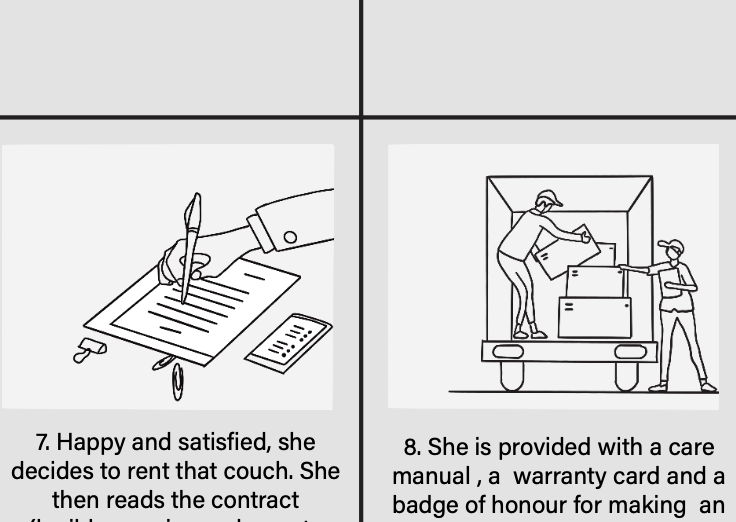
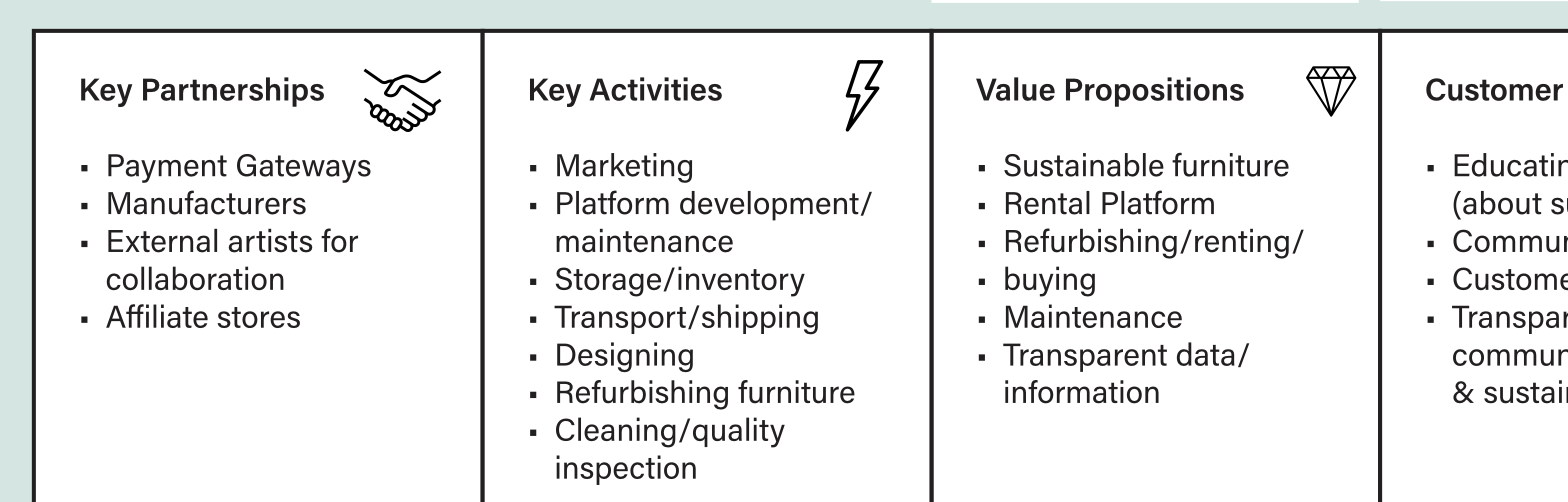
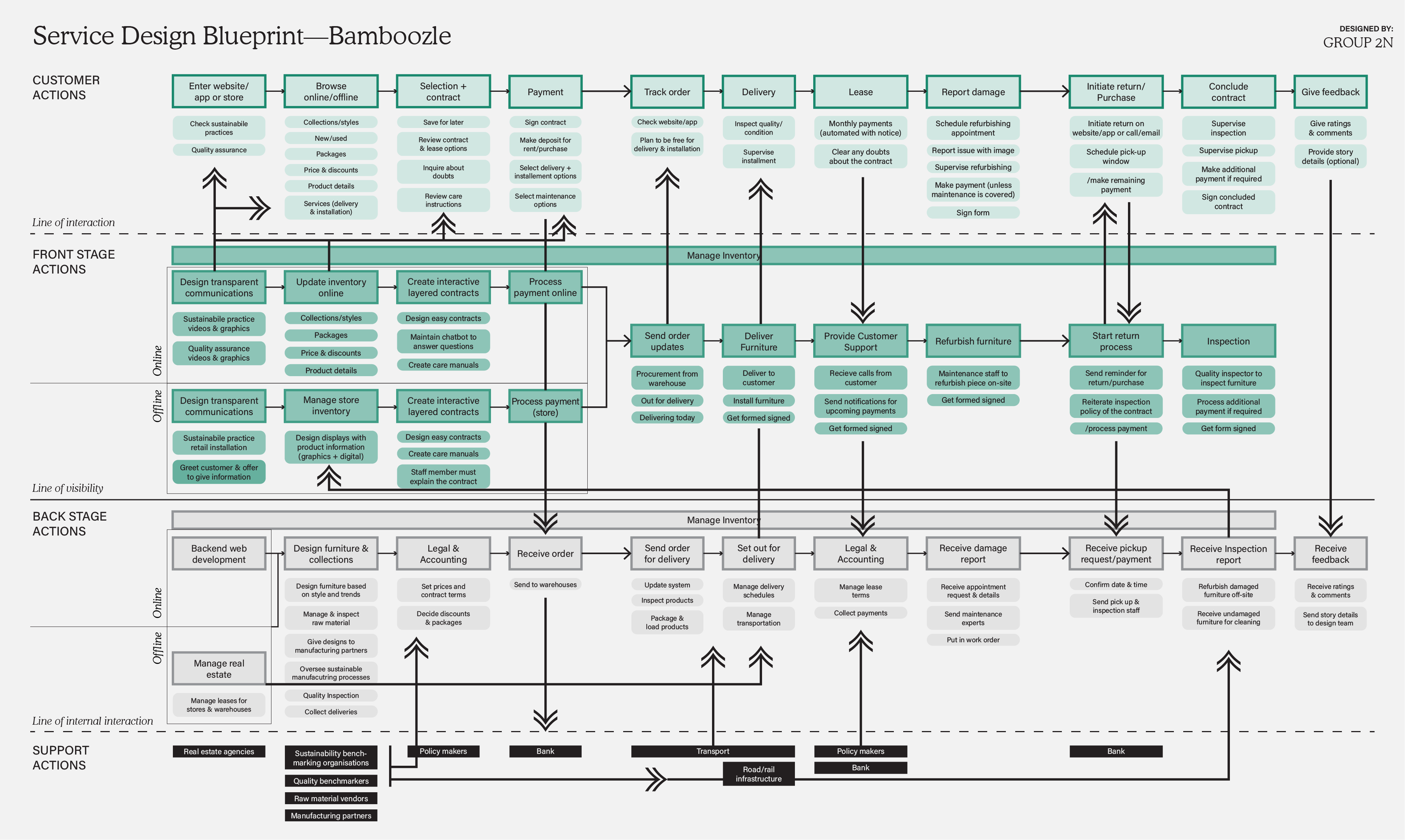
Diverging into the ideation phase, a brainstorming session was conducted to explore potential solutions to the problem statement. Exploring a narrative-driven approach to problem solving, the service concept was storyboarded. A service blueprint and a business model of such a service was then visualised to define the various touch-points within the service and to ensure alignment with the business objectives. (Appendix K -N) (Stickdorn et al., 2018)
These methods resulted in creating a concept of bamboo furniture renting and refurbishing online and offline service with a focus on fostering trust through transparent communication of information on sustainability and quality of its products.
It aims to do so through a few mediums - a user story tag to show how used the product is, a sustainability badge to prove its sustainability trail, quality and hygiene badge guaranteeing its inspection and durability by the quality team always meeting a set standard, and product detail tags (materials, dimensions, capacity, material swatches). Further, the customer will receive a care manual designed legibly and a warranty card (optional) at purchase. Most importantly, the rental contracts will be designed to be legible, precise, and transparent with no hidden clauses for a smooth process of renting and returning. Other key features of the service are as below.
Key features:
1. Affordable rental model:
The core of our concept is a rental based system that allows customers to access high quality sustainable furniture at a fraction of the cost of purchasing. By removing the upfront investment required for furniture ownership the rental model makes eco-friendly options more financially accessible especially for individuals and households facing economic constraints.
2. Furniture refurbishment and reuse:
Integral to our concept is a robust refurbishment and reuse program. Rather than discard used furniture, the rental service will undertake comprehensive refurbishment and restoration processes to extend the lifespan of each piece. This not only reduces waste and resource consumption but also gives new life to furniture, ensuring A continuous cycle of use and reuse.
3. Flexible rental terms:
Recognising the evolving needs of individuals and households, the rental service would provide flexible lease terms. Customers can rent furniture for short-term periods, such as temporary living situations or life transitions, as well as long-term arrangements for more permanent living spaces. This flexibility ensures that the service can adapt to the changing needs of the user.
4. Environmentally responsible supply chain:
The service also means a commitment to environmental responsibility throughout the entire supply chain. This includes sourcing materials from ethical and sustainable suppliers, implementing energy efficient manufacturing processes, and prioritizing the use of renewable, biodegradable, and recycled materials.
Impact:
1. Environmental impact:
- Promote the circular economy model by extending the lifespan of furniture through refurbishment and use.
- Reduces waste and resource consumption associated with the traditional “take-make-waste” model of furniture consumption.
- Encourages a shift towards more sustainable materials sourcing and manufacturing processes.
2. Social impact :
- Enhances accessibility and affordability of eco-friendly furniture options especially for individuals and households facing financial constraints.
- Empowers consumers to make more sustainable choices without compromising their budgets.
- Raises awareness and shifts attitudes towards sustainable living practices.
3. Behavioural impact:
- Encourages a shift in consumer mindset from ownership to access and user-ship.
- Normalises the concept of renting and sharing resources rather than individual ownership.
- Fosters a more sustainable and responsible approach to furniture consumption.
Service Design Blueprint
Evaluation Plan
Prototype & Evaluation Plan
The earlier mentioned solutions to address the problem statement were integrated into various aspects of the service. These solutions were then grouped into different projects and prioritised through a decision matrix to prototype. As it had to be an evaluative, contextual prototype for an experience, a role-playing prototype was conducted to gather evidence on the below hypothesis (Stickdorn et al., 2018).
Hesitant users will be able to gain trust in the quality of rented and used furniture by providing transparent information communicated visually through various mediums such as environmental graphics, certification tags, digital information, and staff in a physical space.
1. Planning
Scope and process: In the user journey of renting a piece of furniture, when a customer is in the physical store to see the options available and learn about its details, this service will provide transparent, visually communicated information through user story tags to show how used the product is, a sustainability badge to prove its sustainability trail, quality and hygiene badge guaranteeing it’s inspection and durability by the quality team always meeting a set standard, and product detail tags that includes materials, dimensions, capacity and material swatches. Users would interact with these mediums by picking them up and reading them aloud or processing them in their mind. These transparent pieces of information were designed to foster trust considering visual design principles to catch the attention of the customer on the vital details and be easy enough to understand quickly. They can further scan the QR code provided, to get detailed information on the app of the service. They would also have the option to interact with the staff during any point of their visit to the store.
Stage: The prototype was conducted during the day, in a set environment representing a rental furniture store, majorly with a couch, coffee table and all the necessary tags and product details placed at different visually - grasping spots within the staging area.
Props: A couch and pillows, coffee table, user story tags, sustainability badges, quality and hygiene badge, product detail tags, QR code and phone.
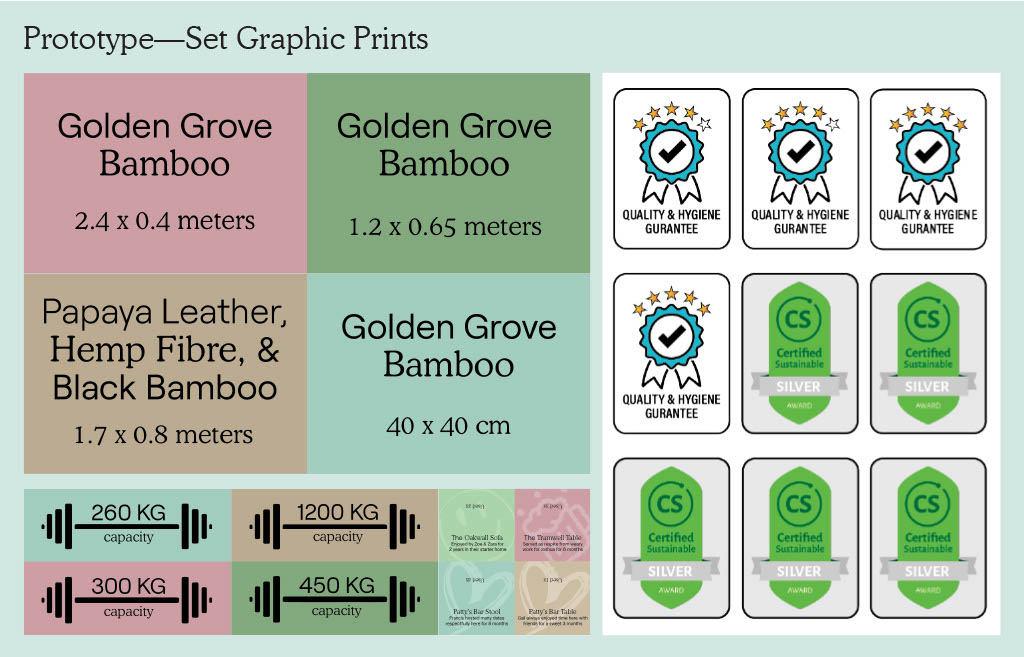
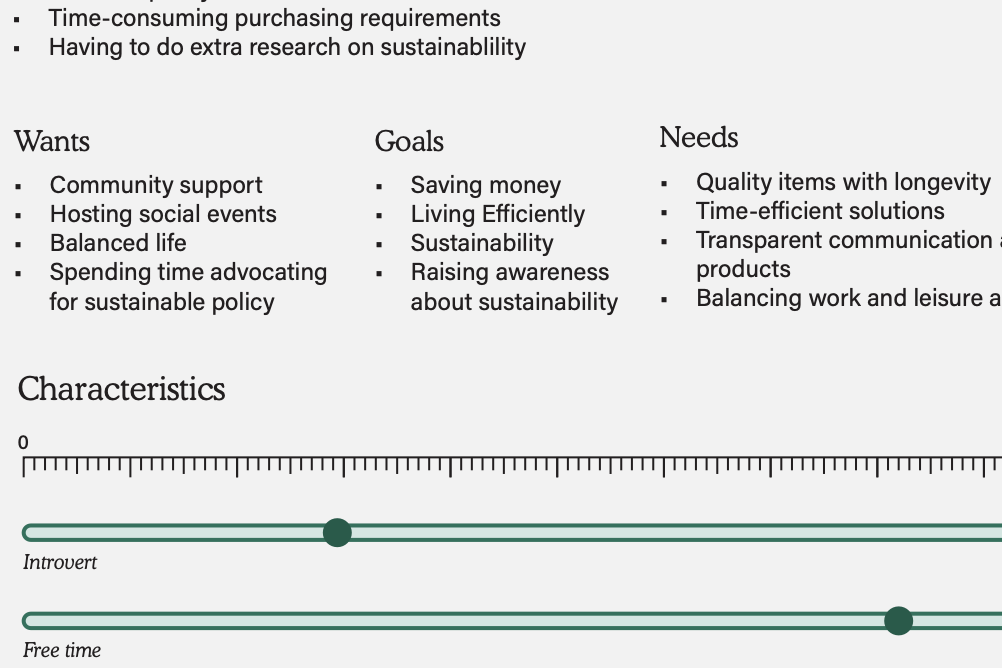
Actors and roles in the team: The current prototype was conducted within the team with one facilitator and researcher, one staff member and two customers representing students doing their masters in London visiting a rental furniture store to potentially rent furniture for their shared apartment, interested in sustainable living but skeptical about the quality of rented furniture.
When replicated with users who are UK residents between the age of 20–45-year-olds recruited through the contact information and consent provided during the earlier conducted surveys and interviews, there will be two facilitators and researchers, one staff member and six customers role playing one at a time to evaluate effectively.
2. Running the prototyping sessions
The script for the role-playing session was prepared keeping the goal of the process in mind. Further, the stage was set up, and customers were briefed on the entire process before the session began. Role-playing was conducted and recorded through a video camera, notes taken by the researcher and concluded with an interview (Appendix O) to learn about the participant’s experience and gather evidence on the hypothesis. The same will be replicated with the recruited 6 participants.
Biases: By assuring participants of their confidentiality, by minimising researcher’s interference during the sessions and having more than one researcher as observer encouraging diverse viewpoints, researcher biases such as confirmation bias, observer via and Hawthorne effect will be mitigated. By clearly defining guidelines and using a standardised set of instructions and processes, participant bias such as experimenter expectancy effect and actor-observer bias will be mitigated.
3. Data analysis
The collected data through video recording, interview and notes taken during the session will go through data cleaning and management process by conducting consistency checks and standardisation of data. Notes and interview data will be analysed through thematic analysis and cross checked with the video footage (Stickdorn et al., 2018).
Conclusion
Conclusion
In conclusion, a comprehensive research plan addressed the challenge of encouraging lower ecological footprint lifestyle changes amid the cost-of-living crisis in the UK and gained valuable insights into consumer attitudes and behaviors. Extensive exploration into the sustainable furniture market and rental sustainable furniture market identified some of the major gaps as lack of awareness and lack of trust amongst consumers, and lack of affordable alternatives, limited availability, and lack of variety in the market. Addressing these gaps, a concept of a sustainable rental and refurbishment furniture service with a major focus on transparency, affordability and quality assurance was proposed. Further, a prototype and evaluation plan were created to test and refine the service concept. Feedback from the participant involvement of the prototyping sessions will help iterate and optimise the solution to meet the evolving needs of consumers and contribute to sustainable living practices in the UK.
View Other Projects